


Know Your Agent Compliance: The CISO Guide to KYA
Know Your Agent (KYA) compliance is the security framework that verifies the identity and authorization of AI agents before they interact with sensitive systems or data. While Know Your Customer (KYC) confirms human identity, KYA ensures every machine actor is authenticated, linked to a verified human principal, and granted only explicit permissions. Built on the Model Context Protocol - Identity (MCP-I) standard, KYA establishes a cryptographic trust chain from human intent through to autonomous execution. According to NIST research, security concerns remain the primary barrier to enterprise AI adoption, and KYA directly addresses this by providing the controls necessary to distinguish authorized agents from malicious actors.
Understanding this framework is the first step toward securing your automated workflows and reducing identity-related risk across your organization. The four fundamental questions KYA answers are: who created this agent, what permissions does it hold, is the human principal verified, and is this authorization still valid.
Why Every CISO Must Prioritize Know Your Agent Compliance Now
The rapid proliferation of autonomous AI agents has introduced a new class of identity and access risk that traditional security controls were never designed to address. NIST explicitly identifies AI agents as creating novel security threats that can impede enterprise adoption if left ungoverned. For CISOs, the imperative to implement KYA compliance is driven by three converging forces: the increasing autonomy of AI systems, the emergence of agentic commerce, and the inadequacy of human-centric identity frameworks in a machine-driven environment.
New Threat Vectors in the Security Stack
AI agents represent a fundamental departure from traditional software. These systems ingest data, make decisions, and execute actions with minimal human intervention. While this delivers significant operational efficiency, it also creates attack surfaces that bypass conventional access controls. NIST identifies security fears as a major barrier to AI agent adoption, noting that organizations cannot trust autonomous actions without robust identity verification for the agents themselves.
Without KYA, a compromised or rogue agent can exfiltrate data, execute unauthorized transactions, or modify critical systems without any human accountability. The damage potential scales with every agent deployed, making KYA a foundational control for any organization adopting AI agent technology.
The Rise of Agentic Commerce
The urgency of KYA extends beyond internal security concerns. The commercial landscape is changing rapidly as major payment and commerce platforms enable direct agent-to-system transactions. Stripe launched its Agentic Commerce Protocol to facilitate AI agent payments, followed by Google's Universal Commerce Protocol. Industry leaders including Walmart, Target, and Visa are actively piloting these capabilities, meaning external agents will soon be interacting with payment systems and data infrastructure daily.
Financial institutions face particular pressure. Reports from American Banker highlight that AI agents are testing the limits of existing banking regulations. Know Your Customer rules designed for human verification do not extend to machine actors. CISOs must close this gap before autonomous agents begin executing financial transactions on behalf of customers, partners, or internal systems.
Adapting Identity Controls for Machine Actors
Traditional identity and access management frameworks assume human users with static credentials. AI agents operate at machine speed, at massive scale, and across distributed environments. NIST emphasizes that auditing and non-repudiation of AI agent actions are critical requirements for safe deployment. This means every agent must have a traceable identity, a verified human principal, and a complete audit trail of every action taken.
Vouched provides the unified identity platform that bridges this gap. While existing security controls remain relevant, they require augmentation to handle autonomous agents effectively. The core priority is ensuring every agent has a cryptographic link back to a verified human user, enabling clear audit trails and enforcing strict operational boundaries.
- Link every agent to a verified human principal with cryptographic proof.
- Define granular permission scopes for each agent deployment.
- Maintain tamper-proof audit logs of all agent actions.
- Re-verify agent authorization on every sensitive action.
How Know Your Agent Compliance Works in Practice
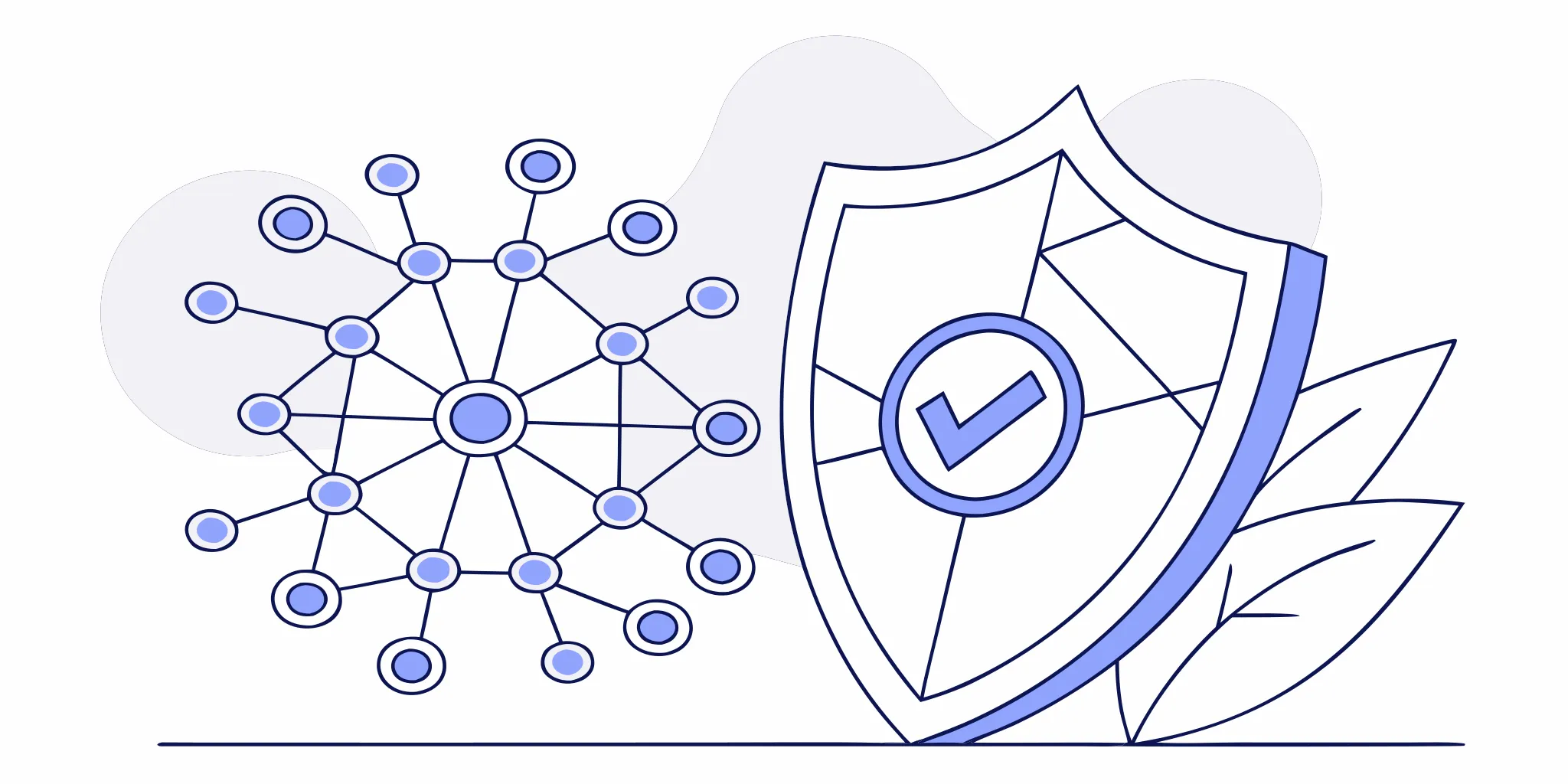
KYA compliance follows a structured five-step process: agent identification, human identity binding, authorization verification, permission enforcement, and continuous audit. Each step builds on the previous to create an unbroken chain of trust from human intent through to machine execution.
Agent Identification
The KYA process begins by identifying every agent attempting to interact with your systems. This initial classification determines whether the agent is a legitimate service bot, an authorized shopping assistant, or a potential security threat. Organizations use detection tools like Vouched AgentShield to fingerprint and categorize agents at the network boundary, ensuring no machine operates anonymously within the environment.
NIST guidelines identify agent discovery and classification as a foundational requirement for secure AI deployment. Without clear identification, agents can conceal their true purpose or bypass security controls entirely. The identification layer establishes the foundation for all subsequent trust verification.
Human Identity Binding
No autonomous agent should operate without a verified human principal. The binding step cryptographically links the agent to a specific human identity through a secure verification process. The system verifies the human first, then binds their verified identity to the agent's unique cryptographic key. This creates an immutable chain of accountability that enables non-repudiation for every agent action.
The KYA implementation follows five sequential stages:
- Agent identification: The system discovers the agent and assigns a unique cryptographic identity for tracking all subsequent actions.
- Human identity verification: The agent's human principal is verified through Vouched Visual IDV, confirming their identity with 99% accuracy in under 10 seconds.
- Authorization confirmation: The system verifies that the human principal has explicitly authorized the specific action the agent is attempting.
- Permission enforcement: Strict permission scopes for AI agents limit access to only the resources and actions explicitly granted.
- Continuous audit: Every agent action is logged with cryptographic proof, creating a tamper-evident audit trail for compliance and forensics.
Permission Enforcement and Audit Trails
After binding identity, the system enforces explicit authorization boundaries for every agent action. Each permission includes scope, duration, and resource limitations. If an agent attempts to exceed its authorized boundaries, the system blocks the action in real time and alerts the security team.
Vouched implements these controls through the MCP-I standard, enabling secure identity assertions that other systems can verify independently. The continuous audit trail provides the data security teams need to demonstrate compliance with regulatory requirements in finance, healthcare, and other regulated industries.
KYA vs. KYC: Bridging Human and Machine Identity
While Know Your Customer verifies human identity at a single point in time, Know Your Agent compliance extends this to continuous verification of machine actors with dynamic authorization checks. The two frameworks complement each other within a unified identity platform that covers every actor in your ecosystem.
The Identity Continuum
Know Your Customer (KYC) has been the standard for human identity verification in regulated industries for decades. It validates government-issued IDs, performs biometric matching, and screens against watchlists. This process is essential for compliance with AML, KYC, and CDD regulations. However, KYC was designed for humans, not for the AI agents that increasingly act on their behalf.
Know Your Agent compliance extends the identity verification concept to machine actors. Rather than verifying a static identity document, KYA performs dynamic authorization checks on every action. It confirms that the agent is who it claims to be, that its human principal is verified, and that the specific action is explicitly authorized. This layered approach addresses risks that KYC alone cannot mitigate in an agentic environment.
| Capability | Know Your Customer | Know Your Agent |
|---|---|---|
| Primary Objective | Verify human legal identity | Verify agent identity and authorization |
| Subject | Human individuals | AI agents and automated software |
| Verification Method | Document and biometric verification | Cryptographic identity and permission checking |
| Regulatory Driver | AML, KYC, CDD compliance requirements | Security, auditability, and risk management |
| Verification Frequency | At account opening and periodic review | Continuous, on every action |
| Accountability Chain | Human identity to legal entity | Agent to human principal to organization |
Vouched's unified platform handles both human and machine identity verification in a single integration. This eliminates the operational overhead of managing separate systems for KYC and KYA while ensuring that every actor in your ecosystem human or autonomous is verified against the same trust standards. The platform reduces integration complexity while providing comprehensive coverage across all identity types.
Reducing Risk in Automated Systems
The transition from human-only to hybrid human-machine identity management introduces significant operational risk. KYA mitigates this by creating an unbroken chain of accountability from every autonomous action back to a verified human principal. This ensures that organizations can answer the critical question: who authorized this action and what was the scope of their authorization?
NIST guidance explicitly requires auditability and non-repudiation for AI agent actions in enterprise environments. Organizations must prove they can identify the human principal behind every agent action and demonstrate that appropriate authorization was in place. This level of assurance is particularly critical in regulated verticals such as healthcare, financial services, and critical infrastructure.
What Are the Key Components of a KYA Compliance Framework?
A comprehensive KYA compliance framework consists of five essential components: agent discovery and classification, human identity verification, granular permission management, continuous authorization enforcement, and immutable audit logging. Each component addresses a specific aspect of the agent identity challenge.
Agent Discovery and Classification
The first requirement is visibility. Organizations cannot secure agents they cannot see. The discovery layer identifies every autonomous entity accessing systems, classifies it by type and risk level, and assigns a unique cryptographic identity. This baseline enables security teams to understand the full scope of their agent attack surface before implementing controls.
Identity Verification and Authorization
Every agent must be linked to a verified human identity through a cryptographically signed attestation. This binding ensures that the organization can always identify the human principal responsible for each agent action. Authorization is then enforced through granular permission policies that specify exactly what resources, actions, and duration are permitted.
Continuous Monitoring and Enforcement
Unlike traditional access controls that verify at login, KYA requires continuous re-authorization throughout the agent's lifecycle. Each action is evaluated against the agent's permission set, with violations blocked in real time and escalated to security teams. This dynamic approach prevents the lateral movement and privilege escalation that static permissions fail to address.
How Does MCP-I Enable Know Your Agent Compliance?
The Model Context Protocol for Identity (MCP-I) is the technical standard that enables KYA compliance by providing a secure, interoperable protocol for agent identity assertions, authorization verification, and audit trail generation across heterogeneous environments.
The Technical Foundation of Agent Identity
MCP-I was developed by Vouched to address the fundamental challenge of agent identity: how do you cryptographically prove that a specific agent was created by a specific human and authorized to perform specific actions? The protocol defines a standard format for identity assertions that any compliant system can verify independently.
The protocol supports cross-platform identity verification, meaning an agent verified through one system can present its credentials to another system without repeating the full verification process. This interoperability is essential as agents increasingly operate across organizational boundaries, accessing multiple services and platforms in the course of a single workflow.
Frequently Asked Questions
What is Know Your Agent (KYA) compliance?
Know Your Agent compliance is the security framework for verifying the identity and authorization of AI agents before they access sensitive systems or data. It ensures every autonomous action is authenticated, authorized by a verified human principal, and fully auditable.
Why do CISOs need KYA compliance?
CISOs face new risk vectors as autonomous AI agents access critical systems with minimal human oversight. KYA provides the identity verification, authorization controls, and audit trails needed to secure agent deployments. Without it, organizations cannot distinguish legitimate agents from malicious actors or maintain accountability for autonomous actions.
How does KYA differ from KYC?
Know Your Customer verifies human identity at account opening through document and biometric checks. Know Your Agent extends this concept to machine actors, verifying the agent's identity and confirming its authorization dynamically on every action. KYC establishes who a person is; KYA establishes what an agent is permitted to do and links every action back to a verified human principal.
What are the technical requirements for implementing KYA?
Implementation requires agent discovery and identification, a secure protocol for identity assertions like MCP-I, granular permission management, real-time authorization enforcement, and immutable audit logging. Organizations should also integrate KYA with existing IAM frameworks to ensure consistent policy enforcement across human and machine actors.
Which industries need Know Your Agent compliance?
Any organization deploying or interacting with AI agents should implement KYA. Healthcare organizations need it to maintain HIPAA compliance when agents access patient data. Financial services firms require it for regulatory compliance and fraud prevention. Ecommerce platforms need it to secure agentic commerce transactions. In regulated industries, KYA is becoming a prerequisite for safe AI agent adoption.
Ready to Secure Your AI Agent Infrastructure?
The window for proactive KYA implementation is closing. As autonomous agents become central to business operations, the security gaps created by unverified machine actors will only grow. Organizations that implement KYA compliance now will have a significant advantage in security posture, regulatory readiness, and operational trust.
Vouched provides the only unified identity platform that handles both human and AI agent verification. Contact our sales team at 1-800-685-3928 to schedule a security assessment and demo of the Vouched KYA platform.